en
en English
 中文简体
中文简体 Español
 Deutsch
In takeaway food packaging, separation matters more than many people outside the industry expect. Customers may not notice the container itself immediately, but they notice very quickly when sushi becomes soggy, sauces leak into dry foods, or fried items lose texture during delivery.
That is one reason 2 compartment disposable food containers became increasingly common in ready-to-eat food packaging.
The goal is not only organizing food visually. The real challenge is controlling moisture migration, structural stability, and transportation performance at the same time.
Inside packaging factories, compartment design affects far more than appearance.
Moisture Migration Quietly Changes Food Quality
One problem with ordinary single-space packaging is moisture transfer.
When warm and dry foods share the same space, condensation gradually spreads across the container interior. Over time, texture changes become obvious. Fried foods soften, rice absorbs excess moisture, and sauces spread into surrounding ingredients.
A properly designed 2 compartment disposable food containers structure helps reduce this interaction by separating foods physically inside the package.
This becomes especially important for:
- sushi combinations
- salad and sauce sets
- rice and side dishes
- bakery assortments
- hot-and-cold meal combinations
In delivery environments, even small moisture differences become noticeable after transportation time increases.
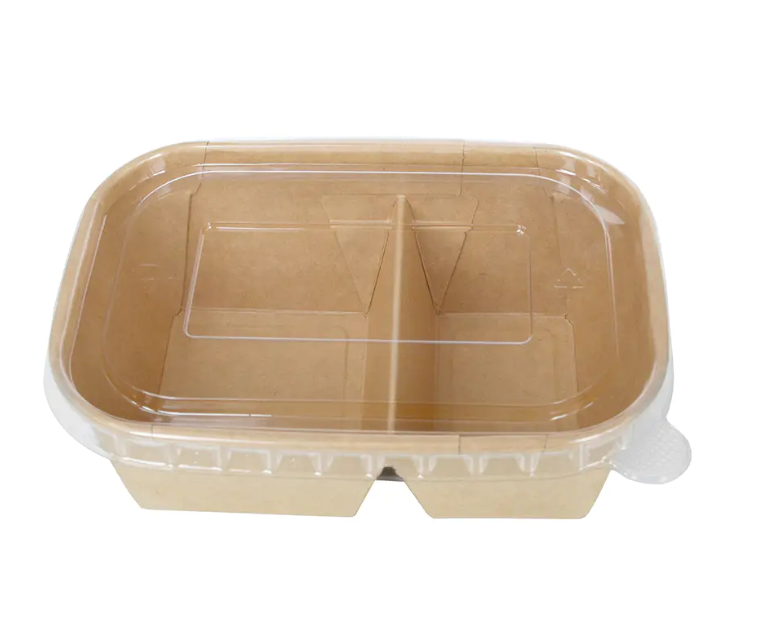
Compartment Shape Affects Structural Strength
Many buyers focus mainly on material thickness when evaluating 2 compartment disposable food containers.
Inside production workshops, compartment geometry often matters more.
Divider walls act as structural reinforcement points across the container body. A well-designed divider increases rigidity and helps distribute stacking pressure more evenly during transportation.
Without sufficient support, containers carrying heavier foods may flex during handling, especially near the center section.
This creates secondary problems such as:
- lid deformation
- unstable stacking
- sauce leakage
- corner collapse
- uneven lid pressure
Factories usually adjust divider depth and edge curvature carefully because those dimensions influence both strength and mold release stability during production.
Food Temperature Changes Packaging Behavior
A 2 compartment disposable food containers product used for sushi behaves differently from one used for hot takeaway meals.
Cold foods mainly challenge condensation resistance and lid clarity. Warm foods create different stress because heat softens some packaging materials during stacking.
In mixed-temperature meals, the situation becomes more complicated.
If one compartment contains hot food while another contains colder ingredients, thermal expansion inside the container becomes uneven. Over time, weak lid structures may lose sealing pressure around certain edges first.
This is one reason takeaway packaging manufacturers test food containers under multiple temperature conditions instead of room temperature alone.
Real delivery environments rarely stay thermally stable.
Lid Alignment Matters More Than Appearance
For many 2 compartment disposable food containers, the lid system quietly determines whether the package survives transportation successfully.
A container may look visually attractive while still failing during delivery because the lid shifts under movement or pressure.
In fast-paced food packaging lines, workers close hundreds of containers continuously. If lid positioning feels inconsistent, efficiency drops immediately.
Professional packaging factories usually monitor:
- latch alignment
- hinge consistency
- sealing pressure
- corner rigidity
- lid rebound stability
Small dimensional variation during molding may affect lid fit much more than consumers realize.
This becomes especially important in automated food packing systems where containers move rapidly through sealing stations.
Oil Resistance Became More Important
Modern takeaway meals often contain sauces, dressings, or oily ingredients. Because of this, grease resistance inside 2 compartment disposable food containers has become increasingly important in commercial food packaging.
Lower-grade coatings sometimes weaken gradually after prolonged oil exposure. At first, the problem may only appear as slight surface darkening.
Later, structural softening or leakage begins appearing around the compartment base.
Paper-based food packaging especially depends heavily on coating stability because the paper itself naturally absorbs moisture and oil without protective treatment.
Factories supplying export food packaging usually test containers under prolonged grease exposure before approving large-scale production.
Stacking During Delivery Creates Hidden Stress
Inside delivery systems, 2 compartment disposable food containers often spend long periods stacked vertically inside insulated transport bags.
That pressure changes container behavior gradually.
A weak divider structure may bend slightly under load, affecting how the lid seals against the upper edge. Once sealing pressure changes, liquid migration between compartments becomes more likely during transportation.
This issue becomes more serious in longer delivery routes where vibration continuously shifts stacked containers.
Good packaging usually feels stable even after movement.
The lid remains aligned, compartments keep their shape, and the structure resists deformation without excessive material thickness.
Visual Presentation Still Matters In Food Packaging
Although structural performance is important, appearance still affects commercial food packaging decisions heavily.
Restaurants choose 2 compartment disposable food containers partly because food presentation influences customer perception immediately after opening the package.
Clear lid transparency, compartment proportion, and surface finish all affect how organized the food appears visually.
This is especially important in sushi packaging where presentation quality strongly influences customer expectations.
For that reason, packaging factories often balance structural rigidity with visual clarity carefully during mold design and material selection.
A container that performs well mechanically but looks visually cloudy or distorted may still fail commercially.
Good Packaging Usually Feels Predictable
Most customers never analyze food containers directly.
They simply notice whether sauces stay separated, lids remain secure, and food arrives looking organized instead of compressed together during delivery.
That is why good 2 compartment disposable food containers rarely attract attention by themselves.
The packaging quietly supports food quality in the background without creating handling problems, leakage, or texture changes during transportation.