en
en English
 中文简体
中文简体 Español
 Deutsch
In food packaging factories, lid performance usually receives more attention than many buyers expect. A container may look clear, lightweight, and neatly molded, but if the lid loses stability during transportation, the entire package becomes unreliable very quickly.
That is one reason hinged deli containers are more technical than they appear at a glance.
Unlike separate lid systems, hinged structures combine the base and cover into one connected piece. This simplifies packaging operations in restaurants, bakeries, salad shops, and takeaway environments, but it also creates different manufacturing challenges.
The hinge area itself becomes a long-term stress point.
The Hinge Usually Fails Before The Container
Many damage in hinged deli containers does not begin on the sidewall or bottom section. The hinge area normally weakens because it bends repeatedly during opening and closing.
Plastic materials behave differently under continuous flexing.
Some lower-grade materials become brittle after refrigeration exposure, while softer compounds may gradually whiten around the hinge after repeated use cycles. Once micro-cracks appear, the lid no longer closes smoothly.
Factories producing food packaging usually pay close attention to hinge memory during mold development.
The material must remain flexible enough to bend repeatedly without creating permanent stress marks too early.
Closing Force Changes Transportation Stability
A hinged deli containers product that closes too loosely creates obvious transportation risks. One that closes too tightly creates different problems because users may damage the hinge while forcing the lid open repeatedly.
That balance becomes especially important in takeaway food environments.
Restaurants often stack containers quickly during busy periods, and unstable lid pressure immediately affects handling efficiency.
Inside packaging workshops, technicians commonly evaluate:
- latch retention force
- lid alignment accuracy
- hinge rebound stability
- sidewall deformation
- repeated opening durability
These details affect daily use much more than decorative appearance.
In real delivery conditions, slight lid instability becomes noticeable very quickly once containers shift during transportation.
Temperature Changes Affect Lid Performance
A lot of people assume plastic food containers behave the same under all conditions.
Actually, temperature changes influence hinged deli containers significantly.
Cold storage may harden certain plastics enough to reduce hinge flexibility, especially around folded sections. Warm food creates different stress because heat softens thinner lid structures slightly during stacking.
This is why containers used for bakery products often differ from those intended for refrigerated deli foods.
In refrigerated display systems, the lid may remain under light compression for extended periods. If material recovery becomes unstable, sealing pressure gradually weakens over time.
That problem usually appears slowly rather than immediately.
Clear Plastic Creates Its Own Manufacturing Challenges
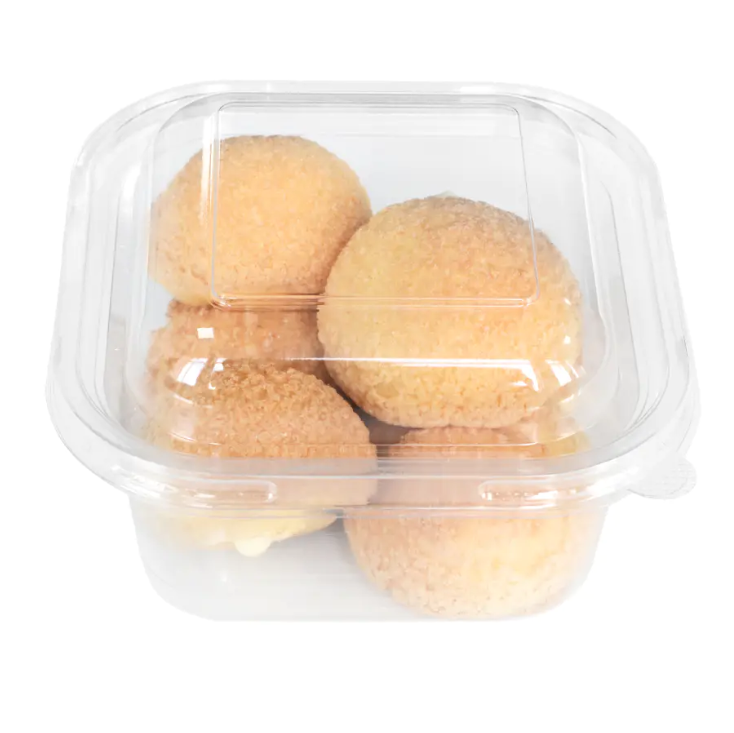
Transparency is one reason hinged deli containers remain popular in food display packaging. Customers can see cakes, salads, fruit, or baked goods directly without opening the package.
However, highly transparent materials are not always easy to process consistently.
Minor molding defects become much more visible on clear plastic surfaces. Flow marks, haze, gate traces, or uneven cooling patterns stand out immediately under store lighting.
This is why packaging factories often pay close attention to mold temperature control and cooling uniformity during production.
For display packaging especially, optical clarity affects product presentation directly.
Stacking Pressure Gradually Changes Shape
During transportation, hinged deli containers may spend hours or days stacked inside cartons under continuous vertical load.
If the sidewall structure lacks sufficient rigidity, slight deformation develops around the lid contact points. Once dimensional accuracy changes, the latch no longer aligns correctly.
This becomes more noticeable in large-size containers carrying heavier food products.
Common long-term problems include:
- corner warping
- unstable lid sealing
- sidewall collapse
- hinge whitening
- latch misalignment
That is why many food packaging manufacturers reinforce corner geometry instead of simply increasing plastic thickness everywhere.
Good structural design usually improves stacking durability more efficiently than adding extra material blindly.
Food Oils Quietly Affect Plastic Surfaces
Another issue factories consider is grease interaction.
Some hinged deli containers are used for pastries, fried snacks, salads, or foods containing oils and sauces. Over time, lower-quality plastics may become cloudy or slightly weakened after long grease exposure.
The effect is gradual but noticeable in display environments where appearance matters.
This is one reason food-contact material stability testing remains important even for disposable packaging products.
Containers designed for dry bakery products sometimes behave differently from those intended for oily takeaway meals.
The packaging application changes the material requirements considerably.
Fast Packaging Environments Need Predictable Containers
In restaurants and bakery kitchens, workers often close hundreds of hinged deli containers during a single shift.
Packaging speed matters.
If the lid alignment feels inconsistent, workers immediately notice the difference. Containers that require excessive force slow down handling efficiency, while loose-closing lids increase leakage risk during delivery.
Good packaging usually feels predictable in daily operation.
The lid closes evenly, the hinge bends naturally, and the latch maintains stable pressure without forcing the plastic structure unnaturally.
Most users never think about these details directly, but they notice very quickly when the container stops behaving consistently during real food service conditions.